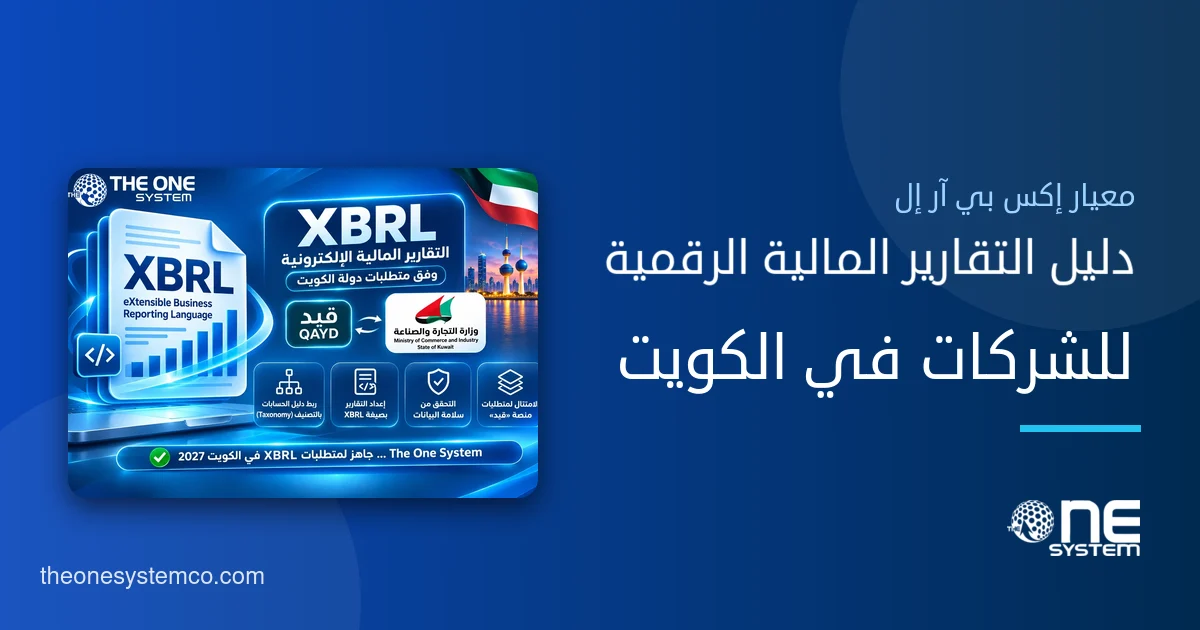
XBRL stands for eXtensible Business Reporting Language, a global standard for representing and exchanging financial data electronically in a structured way. Instead of a financial report being a document that only people can read, every figure in it is defined by an element with a specific meaning, so systems and authorities can read, process and compare it automatically. This guide explains what XBRL is in plain terms, why it matters to companies in Kuwait with the Qayd platform, and how your accounting software links your chart of accounts to it.
What is XBRL in plain terms?
Imagine a printed income statement with the line “Sales: 500,000”. A person understands it instantly, but a computer system does not know whether the figure is revenue or expense, for which year, or in which currency. XBRL gives each figure an “identity card” that states its meaning: this is the revenue element, for this financial year, in Kuwaiti dinars, for this company.
The financial report then becomes a set of structured data rather than a fixed document, and regulators or any other system can extract and compare the figures across companies and years without retyping them. That is why many regulators worldwide have adopted the standard, including the Qayd platform of Kuwait’s Ministry of Commerce and Industry.
Paper report vs. XBRL report
| Item | Paper or PDF report | XBRL report |
|---|---|---|
| Reading | People only | People and machines |
| Meaning of a figure | Understood from context | Defined by a specific element |
| Comparison | Manual and slow | Automatic across companies and years |
| Errors | Found late | Caught during validation before submission |
| Re-entry | Required by the receiving body | Not required |
The core components of XBRL
Four components are enough to understand XBRL:
Taxonomy
The approved dictionary that defines the allowed financial elements, their meaning and how they relate.
Instance document
The file holding the company’s actual values tagged with taxonomy elements; this is what gets submitted.
Context
States the entity and period each figure belongs to, such as the current or comparative year.
Unit
States the type of value, such as Kuwaiti dinars or number of shares.
What is taxonomy mapping?
Mapping is the most important practical step. Every company has a chart of accounts with names and levels that suit it, while the approved taxonomy defines standard elements for all companies. The system therefore needs a mapping layer that links each company account to its matching element.
| Account in the company chart | Matching taxonomy element (illustrative) |
|---|---|
| Branch 1 sales + Branch 2 sales | Revenue |
| Cash box + bank accounts | Cash and cash equivalents |
| Staff salaries | Employee expenses |
| Shop rent | Rent expense |
These examples are illustrative; actual element names are set by the taxonomy version approved by the regulator.
Why XBRL matters to companies in Kuwait
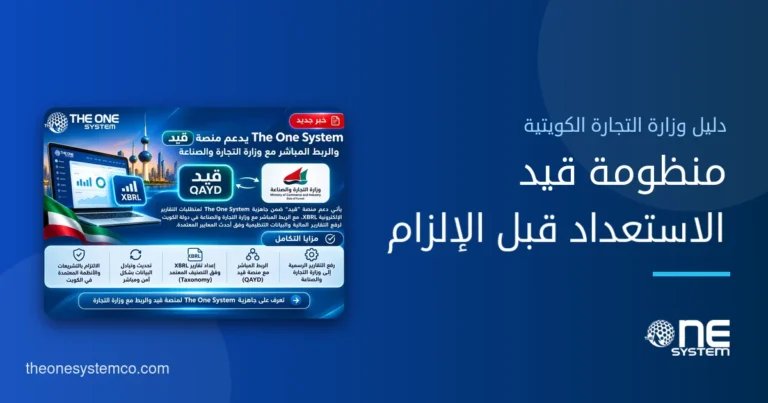
The Ministry of Commerce and Industry launched the Qayd platform to receive financial statements electronically in XBRL format. Per the ministry’s announcement, 2026 is an optional period and the obligation starts in early 2027. Every company concerned therefore needs its financial data organised and mapped to the approved taxonomy before the deadline.
- More organised, clearer reports
- Faster electronic processing
- Easier comparison across years and companies
- Less reliance on manual entry
- Higher-quality financial disclosure
Read our news on The One System and Qayd for the dates and preparation steps.
Why XBRL spread worldwide
Before XBRL, regulators received thousands of financial reports as documents and staff retyped the figures into their systems for analysis, a slow and error-prone process. With XBRL, data arrives ready for analysis, thousands of companies can be compared quickly and unusual values are flagged automatically.
That is why regulators and financial markets in many countries rely on XBRL, and Qayd in Kuwait is part of the same move toward electronic financial reporting.
What does XBRL mean in Kuwait specifically?
In Kuwait, XBRL in practice means the Qayd platform of the Ministry of Commerce and Industry, which receives companies’ financial statements in this format. Companies need their statements mapped to the ministry’s approved taxonomy and submitted according to its procedures.
With 2026 optional and 2027 mandatory, the key question for every company is no longer only “what is XBRL?” but “is my data ready?”. Follow the ministry’s website, moci.gov.kw, for official details.
What does an XBRL report look like inside?
Accountants do not need to write XBRL files themselves, but understanding the idea helps with preparation. An instance document is made of “facts”, and each fact has an element (such as revenue), a value (such as 500,000), a context (the company and financial year) and a unit (Kuwaiti dinars). Together, the facts form the full financial report in a form systems understand.
This is why preparation focuses on the chart of accounts and mapping: once each account is linked to the right element, generating the facts and the instance document becomes an automatic step inside the software.
How The One System prepares you for XBRL
The One System is preparing its accounting platform for XBRL, and the process inside the system follows these stages:
- Company dataDefine the entity details and required basic information.
- Chart of accountsReview and classify accounts, tidying duplicates and unused ones.
- Taxonomy mappingLink accounts and financial elements to the matching categories.
- Financial reportsPrepare the required data and statements from recorded transactions.
- XBRLConvert the data into the required electronic structure.
- Review & submitReview the data against the approved requirements before filing.
Importantly, the company does not have to rebuild its internal chart of accounts; the software adds a mapping layer on top, so daily work stays the same.
Example: from chart of accounts to XBRL report
This is an imaginary example for illustration only, not a real client story:
A service company in Kuwait has accounts such as “Contract revenue”, “Maintenance revenue”, “Office cash”, “Current account bank”, “Technician salaries” and “Admin salaries”. While preparing for XBRL, the accountant reviews them and decides how each maps to the approved taxonomy.
Both revenue accounts map to the revenue element, the cash and bank accounts to cash and cash equivalents, and both salary accounts to employee expenses. The detailed accounts remain in the software because management uses them in internal reports.
After mapping, the accountant produces the year’s statements from the software and each value becomes an XBRL fact with an element, context and unit. During review, a new account added mid-year turns out to be unmapped, so it is linked before conversion. The result is an organised report ready for submission and a saved mapping reused the following year.
Common taxonomy mapping mistakes
- Mapping an account to an element with a similar name but a different meaning
- Forgetting to map accounts added during the year
- Mapping one account to several elements without a clear reason
- Relying on one person’s memory instead of documenting mapping decisions
- Ignoring comparative-year figures when preparing the report
Five steps an accountant can start today
- List the accountsExtract the accounts actually used during the year with their balances.
- Clean upMerge duplicates, deactivate unused accounts and clarify general ones.
- ClassifyMake sure each account sits in the right group and level.
- Map and documentLink accounts to taxonomy elements and record the reason for each decision.
- TestPrepare a past year’s statements the new way and compare them with the approved ones.
How do you know your data is ready for XBRL?
Answer honestly; every “no” is a point to fix before the deadline:
- Is the chart of accounts organised and free of duplicates?
- Can the balance sheet and income statement come straight from the software?
- Is every account with a balance mapped to a taxonomy element?
- Are the company’s basic details complete and up to date?
- Are mapping decisions documented so more than one person understands them?
- Have you tested a past year’s statements the new way?
Is XBRL hard for small companies?
XBRL can look complex for small companies, but the technical part is handled by the software. What the company really needs is an organised chart of accounts and correctly recorded data, which are accounting basics that help the business regardless of regulation.
Small companies benefit most from starting early, because their resources are limited and accounting firms will be busier as the deadline nears. A few hours a week during 2026 is usually enough to reach readiness without pressure.
Common misconceptions about XBRL
“XBRL is just a file format”
The format is a small part; the key is organising data and mapping it to the right taxonomy.
“We must rebuild our chart of accounts”
Not necessarily; you can keep your internal chart with a mapping layer.
“We’ll prepare a week before the deadline”
Organising and mapping take time, and early preparation reveals gaps before the obligation.
“It’s the auditor’s job alone”
The in-house accountant knows the data best, and working with the auditor speeds up review.
Benefits of XBRL for the company itself
Organised financial data
A clear structure of elements and categories inside the system.
Less manual work
Reuse recorded data instead of re-entering it.
Fewer errors
Linking accounts to categories reduces transfer mistakes.
Easier reporting
Prepare statements from inside the system every period.
The structure XBRL requires also improves internal reporting: a clearer chart of accounts, consistent classification across branches and figures that compare easily between periods.
Questions & answers
XBRL: frequently asked questions
Short clarifications on the points that confuse accountants most when they first meet XBRL.
01What is XBRL?
XBRL is a standard language for representing financial data and reports electronically in a structured way, where each figure is defined by an element that systems can read.
02How is XBRL related to Qayd in Kuwait?
The Ministry of Commerce and Industry’s Qayd platform uses XBRL to receive companies’ financial statements electronically.
03What is a taxonomy?
It is the approved classification that defines the allowed financial elements, their meaning and relationships.
04Do I need to change my chart of accounts?
Not necessarily; you can keep your internal chart of accounts and add a mapping layer to the approved taxonomies.
05When does XBRL filing become mandatory in Kuwait?
According to the ministry, filing through Qayd is optional during 2026 and mandatory from the start of 2027.
Didn’t find your answer? Our team is happy to help.
Related articles and news
The One System and XBRL — Qayd and the Ministry of Commerce — Accounting software in Kuwait — Accounting software for companies.