
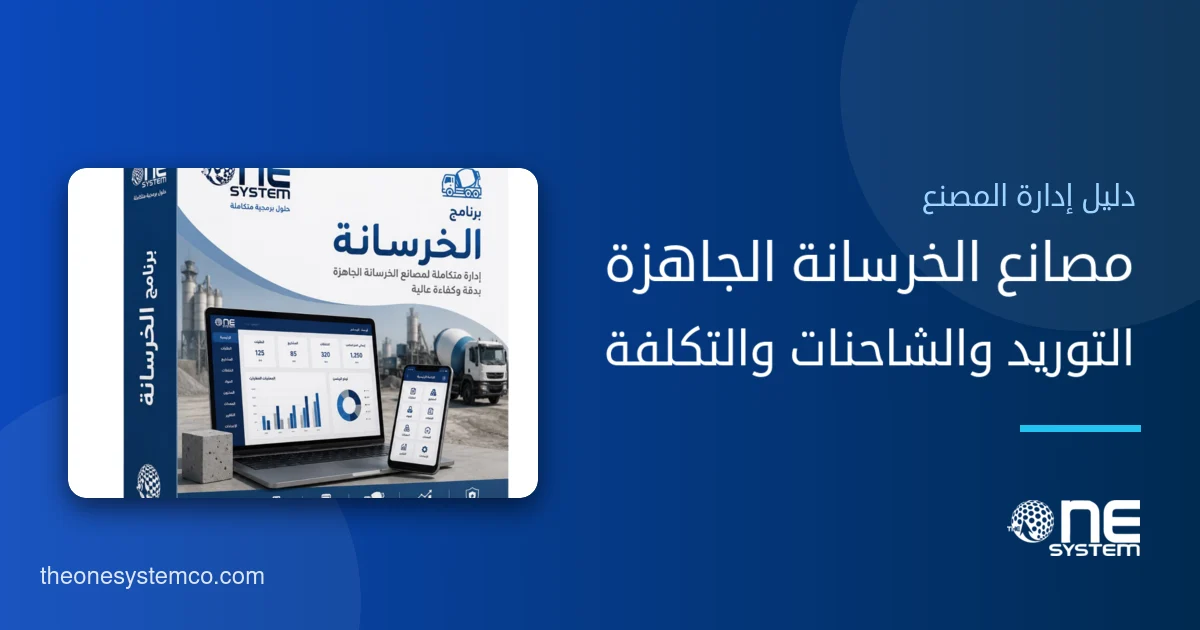
Ready-mix concrete software is a system that brings supply orders, trucks, drivers, plants, raw materials and accounts into one database, so a plant knows what it produced, what it delivered, to whom, and what each cubic metre cost. The One System’s concrete software provides these functions for ready-mix concrete production and supply companies, together with invoices, receipt and payment vouchers, journal entries and cost per cubic metre.
The One System is a business software company working since 2004, with its head office in Kuwait and offices in Cairo and Asyut, serving companies in Kuwait, Egypt, Iraq, Saudi Arabia, Libya and Mauritania. This guide explains what a concrete plant needs from its system, how the software calculates cost per cubic metre, how to choose the right concrete plant management system, and which mistakes to avoid when going live.
What are the main challenges of ready-mix concrete plants?
The main challenge of a ready-mix concrete plant is that the product cannot be stored, while operations, inventory and accounts all move at the same time. Concrete is mixed to order and delivered straight to the customer’s site, so a problem in one link shows up in all the others. Most plants face the following challenges:
A product that can’t wait
Concrete is mixed to order and shipped immediately, so any delay in preparing an order or dispatching a truck affects both the customer and the plant’s schedule.
A constant flow of supply orders
The plant receives orders from different customers and projects on the same day, each with its own quantity, time and delivery site.
Many trucks and drivers
Trucks move between the plant and project sites all day, and without a system it is hard to know what each truck carried and what each driver did.
Fast-moving raw materials
Cement, sand, aggregate and admixtures are bought and consumed daily, and the gap between purchased and consumed quantities directly affects cost.
Cost that is hard to track
Production cost is spread across materials, fuel, trucks, salaries and expenses; recorded in separate places, the real cost picture is lost.
Licences and documents with deadlines
Truck licences and drivers’ residence permits have renewal dates, and one missed date can take a truck or driver off the road.
These challenges share one cause: data scattered across notebooks, spreadsheets and different people. That is why a general accounting program alone is not enough, and neither is a spreadsheet per department. A plant needs concrete batching plant software that links operations to accounts, from the first supply order to the last receipt voucher.
What does a concrete plant need from its system?
A concrete plant needs its system to connect three circles in one place: operations (supply orders, trucks and plants), inventory (cement, aggregate and admixtures) and accounts (invoices, collections and production cost). The checklist below sums up what any concrete plant system should provide:
- Organised supply orders: every order recorded with customer, project, quantity and delivery time.
- Truck and driver management: data for each truck and driver, linked to the supply orders they carried out.
- Delivered quantity tracking: knowing exactly what reached each customer and each project.
- Plant and crusher management: following every batching plant and crusher within the same system.
- Raw material inventory: tracking purchases of cement, sand, aggregate and admixtures and their consumption in production.
- Cost per cubic metre: gathering production costs and linking them to produced quantities and sales.
- Customer and project accounts: supply invoices, collections and a statement for every customer and project.
- Full accounting: receipt and payment vouchers, journal entries and operating expenses in the same system.
- Management alerts: reminders before truck licences and drivers’ residence permits expire.
- Production and supply reports: quantities produced and delivered per project, sales and cost per cubic metre.
The One System’s concrete software covers all three circles: it manages trucks, drivers and supply orders, tracks cement, aggregate and admixture stock, records supply invoices, customer and project accounts and operating expenses, and calculates cost per cubic metre. The software sends invoices and supply notifications to customers on WhatsApp and SMS, and records attendance for plant shifts and drivers.
How does the software manage supply orders and trucks?
The software manages supply orders and trucks by turning every customer request into a recorded supply order, then linking it to the truck, the driver and the delivered quantity all the way to the invoice. In an integrated system the supply cycle usually runs like this:
- Record the supply orderSales or dispatch staff record the order under the customer and project, with the required quantity, delivery time and site.
- Assign truck and driverThe supply order is linked to the truck and driver responsible, so management knows who handles each order.
- Load at the plantThe truck is loaded at the batching plant and the quantity leaving on each trip is recorded.
- Deliver and record the quantityThe quantity that actually reached the site is recorded, building an accurate log of deliveries per customer and project.
- InvoiceDelivered quantities become a supply invoice on the customer and project account, with no re-entry into another program.
- Notify the customerThe software sends the invoice or supply notification to the customer on WhatsApp or SMS.
The One System’s software keeps data on drivers and plant workers and their salaries, and records attendance for plant shifts and drivers automatically. It alerts management to important events, such as truck licence renewals and drivers’ residence permits, so no truck or driver is stopped by an expired document.
A good concrete plant system also gives a clear view of every truck: the quantities it carried, the projects it served and the drivers who worked on it. That view helps management spread trucks fairly across orders, spot trucks that need attention or maintenance, and compare driver performance objectively.
The biggest advantage of managing supply inside an integrated system is that each quantity is recorded only once. The quantity that left the plant and reached the project is the same one that appears on the invoice, the customer statement and the production report — so there are no gaps between what dispatch says and what accounts say.
How does the software manage plants, crushers and raw materials?
The One System’s concrete software manages concrete plants, crushers and raw material inventory within one system, tracking what comes into the plant and what is consumed in production. This covers the following areas:
Batching plants
Each batching plant is followed in the system, with its output linked to supply orders and delivered quantities.
Crushers
Crushers are managed in the same system, because the aggregate they produce or supply is a core input of concrete.
Cement, sand, aggregate and admixtures
Raw material balances, purchases and consumption in production are tracked, with the available balance visible at any time.
From inventory to cost
Materials consumed in production are the largest component of cost per cubic metre, so inventory feeds directly into the cost calculation.
A concrete plant management system is especially useful for companies that run more than one plant, or combine a batching plant with a crusher. The owner then needs to see each unit on its own and the whole company together at the same time. The One System’s software supports multiple branches and companies and works online, so management can follow its plants from anywhere.
A good system also compares purchased materials, consumed materials and actual output on a regular basis. If a plant uses an amount of cement that does not match the concrete it produced, the gap shows up early in the reports, and the cause can be traced: a recording error, waste in operation, or a difference in what was received from the supplier.
How does the software calculate cost per cubic metre?
The software calculates cost per cubic metre by adding up production costs for a set period — raw materials consumed, fuel, truck operation, salaries and expenses — and dividing them by the quantity produced in the same period. The One System’s concrete software calculates cost per cubic metre and links it to sales and accounts. The general method that concrete plant systems follow runs through these steps:
- Set the period and unitChoose the period (for example a day or a month) and the unit being costed: the whole plant, one batching plant, or a specific project.
- Raw materials consumedAdd the cost of the cement, sand, aggregate and admixtures actually consumed in production, at their purchase cost recorded in inventory.
- Fuel and truck operationAdd fuel for the plant and trucks, their maintenance and other direct operating expenses.
- Salaries and labourAdd the salaries of drivers and plant workers related to production during the period.
- Other operating expensesAdd general plant expenses such as electricity, water and equipment maintenance, allocated to production on a clear basis.
- Divide by quantity producedDivide total cost by the cubic metres produced in the same period to get cost per cubic metre.
- Link to salesCompare cost per cubic metre with sales revenue for each customer or project, so the plant sees where margins are healthy and where they need review.
Note: this guide gives no figures for cost per cubic metre, because cost varies from plant to plant with material prices, mix type, distances and how expenses are allocated. What matters is a consistent, transparent method whose inputs come from data actually recorded in the system, not from estimates.
The value of ready-mix concrete accounting software at this step is that the cost inputs already live inside the system: consumed materials from inventory, salaries from employee records, expenses from payment vouchers and journal entries, and quantities from supply orders. The accountant does not have to gather them by hand from scattered sources at the end of every month.
A good system can also separate cost by mix type, since each mix uses different proportions of cement and admixtures. That separation helps management price its concrete for customers on a sound basis and see which mixes are the most profitable.
How does the software track customer and project accounts?
The software tracks customer and project accounts by posting supply invoices to each customer and each project, then matching them against receipt vouchers and collections. In the concrete sector one customer may run several projects at once, each with its own quantities, invoices and payments.
The One System’s concrete software records supply invoices, customer and project accounts, operating expenses and production cost. It records every financial transaction of the plant, from receipt and payment vouchers to journal entries. This part rests on the same accounting foundation as The One System’s general accounting software: vouchers, journal entries, general ledger, trial balance and final accounts.
- A statement per project: the plant knows what it delivered to each project, what it collected and what is still due.
- A consolidated customer statement: the accountant sees the customer’s balance across all their projects.
- Invoices linked to deliveries: every invoice rests on recorded delivered quantities, so customer queries are easy to answer.
- Collection follow-up: due and overdue amounts show for each customer, so management follows up before they pile up.
- Electronic invoice sending: the software sends invoices and supply notifications to customers on WhatsApp and SMS.
This link between supply and accounts is what separates concrete plant software from a general accounting program. If your company needs a wider accounting system covering other activities alongside concrete, read our guide to accounting software for companies to see what an accounting system should offer the business as a whole.
Which reports does a concrete plant need?
A concrete plant needs reports that answer three daily questions: how much did we produce and deliver, to whom, and at what cost. The One System’s concrete software provides production and supply reports showing quantities produced and delivered per project, sales and cost per cubic metre, among the 150+ analytical reports in The One System’s software.
Production reports
Quantities produced in the period, broken down by plant and time period.
Supply reports
Quantities delivered to each customer and project, compared with quantities ordered.
Cost reports
Cost per cubic metre, its components and how it changes from period to period.
Sales reports
Plant sales by customer, project and period.
Customer and collection reports
Customer and project balances, amounts due and amounts collected.
Raw material reports
Balances, purchases and consumption of cement, sand, aggregate and admixtures.
A good system presents these reports in a form each level of the company understands: the owner wants a short view of output and profitability, the operations manager wants truck and plant detail, and the accountant wants customer balances and expenses. When every report comes from one database, the figures match however they are presented.
Spreadsheets or an integrated concrete plant system?
An integrated system suits a concrete plant better than spreadsheets because it records each transaction once and links it to every other part of the plant automatically. The comparison below shows the difference in the key areas:
| Area | Spreadsheets and notebooks | Integrated concrete plant system |
|---|---|---|
| Supply orders | Kept in a separate sheet per employee or day | Recorded in the system and linked to customer, project and truck |
| Delivered quantities | Copied by hand into invoices and may not match | Turned directly into supply invoices |
| Raw materials | Estimated balance updated at stock counts | Recorded purchases and consumption, balance available any time |
| Cost per cubic metre | Worked out by hand at period end from scattered sources | Calculated from recorded inventory, expense and quantity data |
| Customer accounts | Statements prepared by hand on request | A statement per customer and project ready at any moment |
| Alerts | Depend on staff memory | Alerts for licence and residence permit dates |
| Customer communication | Scattered manual messages | Invoices and supply notifications sent on WhatsApp and SMS |
| Reports | Compiled by hand, figures may conflict | Reports from one database with matching figures |
| Multiple plants | A file per plant, hard to consolidate | Each plant and the whole company followed together |
Spreadsheets may be enough in the first weeks of a small plant, but they become a burden as trucks, customers and projects grow. The problem is not the spreadsheets themselves but that each one lives apart from the others, so data is duplicated and figures conflict.
How do you choose concrete batching plant software?
You choose the right concrete batching plant software by making sure it covers operations and accounts together, and that its provider can train and support your team. These criteria apply to any program you compare:
- Built for concrete: make sure the software understands supply orders, trucks and plants, rather than being general accounting software with renamed screens.
- Cost per cubic metre: ask how the software calculates cost and where its inputs come from.
- Supply linked to invoicing: check that delivered quantities become invoices without re-entry.
- Raw material management: confirm it tracks purchases and consumption of cement, aggregate and admixtures.
- Project accounts: ask whether it keeps each project’s account separate for the same customer.
- Multiple plants and branches: if you run more than one plant, confirm multi-branch support.
- Arabic language: choose software that works fully in Arabic and English.
- Training and support: ask about training for dispatch and accounts staff and technical support after go-live.
- Provider experience: a provider with many years in business software is better placed to maintain and develop the system.
The One System’s concrete software meets these criteria: it is designed specifically for ready-mix concrete production and supply companies, works in Arabic and English, and dispatch and accounts staff are trained on it free of charge, with one year of free technical support and continuous free updates.
What are the common mistakes when running a concrete plant system?
The most common mistake when running a concrete plant system is using it for accounts only and leaving operations outside it. The following mistakes also recur, and all of them can be avoided with planning:
Separating supply from accounts
If supply orders stay in external sheets, management loses the link between quantities, invoices and cost.
Not recording consumption
Recording purchases without recording material consumption in production leaves the cost calculation incomplete.
Changing the expense allocation
Changing how expenses are allocated from month to month makes cost per cubic metre impossible to compare across periods.
Training only one person
Success depends on dispatch, accounts and plant staff each being trained on the part that concerns them.
Ignoring alerts
Turning on licence and permit alerts and then ignoring them brings back the problem of expired documents.
Not reviewing reports
Reports only help if they are reviewed regularly, so set a fixed time to review output, cost and collections.
Illustrative example: what does a day look like in a plant running an integrated system?
The following example is hypothetical, for illustration only, and does not represent a real client or actual figures. It shows how the plant’s departments connect inside one system:
- Morning: taking ordersA hypothetical plant receives supply orders from several projects, and the dispatch clerk records them in the system under customer, project, quantity and time.
- Assigning trucksThe operations manager links each supply order to a truck and driver, and sees in the system that one truck’s licence is nearing renewal, so arranges it in advance.
- During the day: deliveryTrucks leave the plant, delivered quantities are recorded for each project, and production consumes cement, aggregate and admixtures that are recorded in inventory.
- Invoicing and notificationDelivered quantities become invoices on each project’s account, and the system sends the invoice to the customer on WhatsApp.
- Month end: cost and reportsThe accountant reviews the cost per cubic metre report, built from consumed materials, expenses, salaries and produced quantities, and compares it with sales for each project.
In this example no one re-entered the same data twice, and the owner did not wait for month end to know the state of production and collections. That is the practical difference ready-mix concrete software makes compared with scattered work.
Why choose The One System’s concrete software?
The One System offers software designed for ready-mix concrete production and supply companies, plus the features shared by all its systems:
Experience since 2004
Our team has been building software for businesses in the region for more than twenty years.
Built for concrete
The software manages trucks, drivers, supply orders, plants, crushers and raw materials.
WhatsApp and SMS
The software sends invoices and supply notifications to customers on WhatsApp and SMS.
150+ reports
The One System’s software provides more than 150 analytical reports.
Online and multi-branch
The system works online from anywhere and supports multiple branches and companies in Arabic and English.
Free training and support
Free staff training, one year of free technical support and continuous free updates.
The One System serves concrete plants in Kuwait from its head office and in Egypt from its offices in Cairo and Asyut, and works with companies in Iraq, Saudi Arabia, Libya and Mauritania. For details of the modules and screens, visit the ready-mix concrete software page — Useful source: Ready-mix concrete (Wikipedia).
Questions & answers
Ready-mix concrete software FAQ
Short answers to what concrete plant managers ask most before choosing a system.
01What does a concrete plant need from its system?
A concrete plant needs its system to manage supply orders, trucks and drivers, follow plants, crushers and raw material stock, record invoices and customer and project accounts, calculate cost per cubic metre and produce production and supply reports — all in one system.
02How is cost per cubic metre calculated in the software?
Cost per cubic metre is calculated by adding up production costs for a set period — raw materials consumed, fuel, truck operation, salaries and operating expenses — and dividing them by the quantity produced in the same period. The One System’s concrete software calculates cost per cubic metre and links it to sales and accounts.
03Does the software manage trucks, drivers and supply orders?
Yes. The One System’s concrete software organises supply orders, manages trucks and drivers, and tracks delivered quantities for each customer and project.
04Does the software manage plants, crushers and raw materials?
Yes. The software manages concrete plants and crushers and tracks stock, purchases and production consumption of cement, sand, aggregate and admixtures.
05Does the software send invoices and supply notifications to customers?
Yes. The software sends invoices and supply notifications to customers on WhatsApp and SMS.
06Is the concrete software bilingual?
Yes. The One System’s software works in Arabic and English, runs online from anywhere and supports multiple branches and companies.
07Is the plant team trained on the software?
Yes. Dispatch and accounts staff are trained free of charge on supply orders, trucks and cost calculation, with one year of free technical support.
Didn’t find your answer? Our team is happy to help.
Want to see the software working on your plant’s data?
Book a demo with The One System team and we will walk you through supply orders, trucks and cost per cubic metre, or contact us directly on WhatsApp.