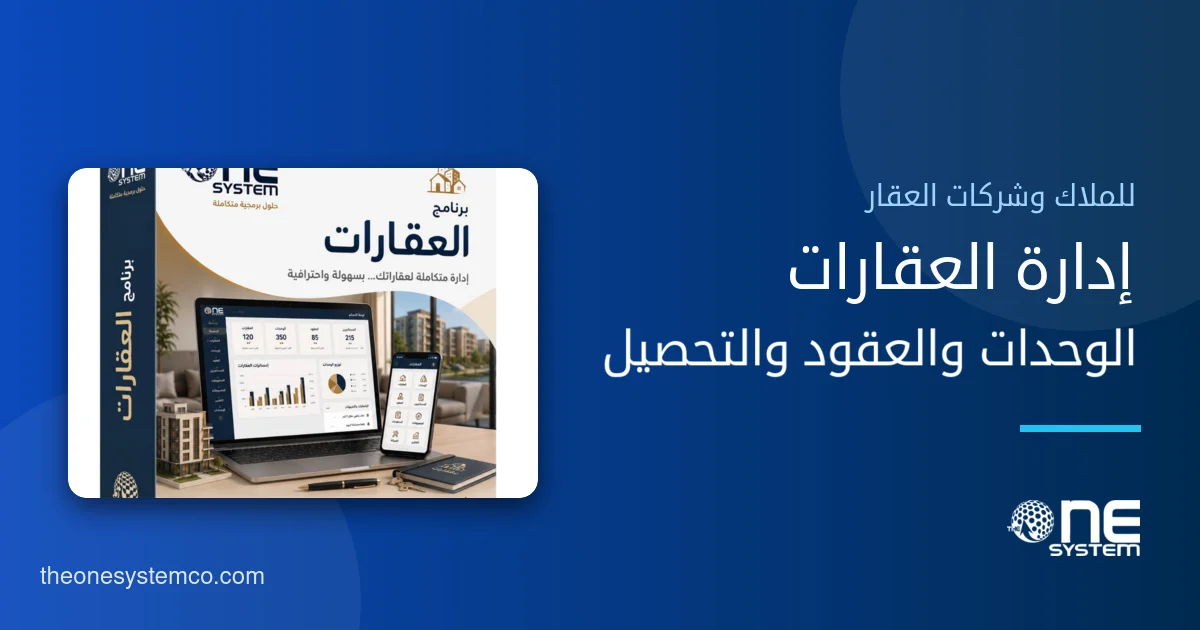
Real estate management software brings properties, units, lease contracts, tenants and rent collection together in one place, and alerts you automatically before contracts expire and when payments are late. The One System’s real estate software provides these functions, along with WhatsApp and SMS reminders to tenants, a record of guarantees and deposits, maintenance follow-up, and yield, occupancy and arrears reports for each property.
The One System has developed business software since 2004. Its head office is in Kuwait, with offices in Cairo and Asyut, and it serves companies in Kuwait, Egypt, Iraq, Saudi Arabia, Libya and Mauritania. This article explains who property management software is for, how to choose the right system, and what it should cover across units, contracts, collection, maintenance and reporting, with a practical comparison between working in Excel or a notebook and working in a dedicated system.
Who is real estate management software for?
Real estate management software suits anyone who rents out units and needs to follow up contracts and payments consistently, whether they manage one building or a portfolio of properties.
Property management companies
Firms managing properties on behalf of several owners, which need separate owner accounts and collection tracking per property.
Building owners
Owners renting out apartments, shops or offices who want to see leased and vacant units and overdue amounts without manual calculations.
Commercial and residential complexes
Complexes with many units and tenants that need contracts and maintenance requests organised in one system.
Collection and maintenance teams
Field teams that need to know each day’s dues and open maintenance requests, with attendance and payroll tracked.
What these groups share is income that arrives as periodic payments tied to contracts with a start and an end date. The more units you have, the harder it becomes to remember due dates and renewals by hand, and the more likely delays and oversights become. That is why property management software is an organisational tool before it is an accounting tool.
What is the best real estate management software?
The best real estate management software links each unit to its contract, tenant and payments, alerts you before a payment is late, and produces yield reports per property. These criteria help you compare the systems available:
- Properties and units: records each property and its units, and shows whether each unit is leased or vacant.
- Contracts linked to tenants: stores the contract term, rent amount and payment schedule, linked to the unit and tenant.
- Collection tracking: shows what has been collected and what is overdue, per tenant and per property, at any time.
- Automatic alerts: warns before a contract expires and when a payment is late, instead of relying on staff memory.
- Tenant communication: sends rent reminders and receipts by WhatsApp and SMS.
- Connected accounts: links rents, expenses and owner accounts to the books and financial statements.
- Yield and occupancy reports: measures each property by yield, leased units and arrears.
- Local support and training: a team that helps with the initial data entry and trains your staff.
The One System’s real estate software combines these elements in one system that works online from anywhere, supports Arabic and English, and suits multi-branch and multi-company businesses. The final choice still depends on the size of your portfolio and how your team works, so it helps to try the system on data close to your own before deciding.
How does the software manage units and properties?
The One System’s software manages properties and units by defining each property, recording its units, and linking each unit to its contract and tenant.
Property management starts with a clear register. The software defines the property, then records the units under it, such as apartments, shops and offices. From then on, users can see at any moment which units are leased and which are vacant, who the current tenant of each unit is, and when their contract ends.
This structure saves a lot of time when answering queries. Instead of searching scattered files for a particular unit’s contract, staff open the unit and find the contract, tenant and related payments. The same structure makes occupancy reporting easier, because each unit’s status lives in the system rather than in someone’s memory.
For companies managing properties for different owners, the software keeps owner accounts, so each owner sees the income and expenses that relate to their properties. That is the basis of transparency between the management company and the owner.
How does the software organise lease contracts and tenants?
The One System’s software organises lease contracts by linking each contract to the unit, the tenant and the payment schedule, and keeps each tenant’s details in a single record.
The lease contract is the core of the relationship with the tenant. A rental management system records the contract essentials: the unit, the tenant, start and end dates, the rent amount and the payment frequency. From these, the schedule of due payments takes shape, so the team knows what to expect in each period.
The software keeps a record for each tenant, with contact details, contracts, past payments and arrears. As a contract approaches its end, the system alerts you in advance, leaving time to negotiate a renewal or prepare the unit for a new tenant instead of discovering the expiry after the fact.
If your company wants to manage relationships with tenants and owners more broadly, The One System’s CRM software includes a real estate section explaining how that relationship is handled inside the real estate software.
Does the software track rent collection and late-payment alerts?
Yes. The One System’s real estate software tracks rent collection, alerts you automatically when payments are late, and sends rent reminders and receipts to tenants by WhatsApp and SMS.
Collection is where the difference between manual work and rental management software shows most. Manual collection depends on reviewing statements and remembering dates; in the system, the cycle follows clear steps:
- Payment schedule: the software sets the due dates from the lease contract details.
- Reminder before the due date: the system sends the tenant a rent reminder by WhatsApp or SMS.
- Recording the payment: the collector records the payment and the software sends the tenant a receipt.
- Late-payment alert: if a payment is not made on time, the software flags the delay.
- Arrears follow-up: arrears reports show the uncollected amounts per tenant and per property.
With this cycle, no payment is lost to forgetfulness, and managers know at any time how large the arrears are and who is responsible for following them up. The software also records collection staff details and tracks their attendance through fingerprint devices, so each person’s responsibilities are clear.
How does the software handle maintenance and guarantees?
The One System’s software manages maintenance and service requests, tracks maintenance supplies, their purchase and their issue to properties, and records tenants’ guarantees and deposits.
Maintenance is a constant part of running any property. The software records maintenance and service requests, so the team can follow open and completed requests. It also tracks maintenance materials and supplies and their purchase, and records what is issued to each property, so maintenance spending appears under that property’s expenses.
Guarantees and deposits are amounts a tenant usually provides when signing, and they need an accurate record because they fall due or are settled when the contract ends. The software records guarantees and deposits, so the team knows what the company holds for each tenant without digging through old paperwork.
The software also records the property team — maintenance, security and collection staff — and their salaries, so everything related to a property sits in one system: units, contracts, expenses and the people who run it.
Which yield reports does the software provide?
The One System’s real estate software provides real estate yield reports, leased and vacant unit reports, and arrears reports for each property, alongside receipts, payments and accounting reports.
Real estate yield
Measures what each property earns against its expenses, so you can see which properties perform best.
Occupancy
Shows leased and vacant units in each property, so you can see where marketing effort is needed.
Arrears
Identifies overdue amounts per property and per tenant, pointing the collection team to priorities.
Property accounts
Shows collected and overdue rents, property expenses, owner accounts and financial statements.
Good real estate accounting software connects to the company’s general ledger, so rent figures never drift away from the books and financial statements. The One System also develops general accounting software, and its systems offer more than 150 analytical reports, giving management a complete financial picture instead of scattered spreadsheets.
The value of these reports lies in the decisions they support. The occupancy report shows which properties need their vacant units marketed, the arrears report identifies tenants who need closer follow-up, and the yield report compares properties with one another. When these reports come straight from the system, management does not have to wait for spreadsheets to be compiled at the end of each period, and owners get a clear statement of their properties whenever they ask.
Excel or a notebook vs a property management system: what’s the difference?
Excel or a notebook works for a handful of units, but a dedicated system becomes essential once contracts, payments and tenants multiply.
| Item | Excel or notebook | Property management system |
|---|---|---|
| Unit status | Updated by hand and can fall behind | Leased or vacant, linked directly to the contract |
| Payment dates | Remembered by staff or checked in the sheet | Scheduled from the contract details |
| Contract expiry | Sometimes noticed only after the date | Alert before the contract ends |
| Arrears | Need manual calculation and matching | Late-payment alerts and a report per property |
| Tenant reminders | Individual calls or messages | Reminders and receipts by WhatsApp and SMS |
| Guarantees and deposits | Loose papers or scattered columns | A clear record for each tenant |
| Accounts | Separate from the books and statements | Linked to owner accounts and financial statements |
| Teamwork | Several copies of the same file | One online system for the whole team |
This does not make Excel a bad tool; it is useful for quick analysis. The problem starts when the spreadsheet becomes the only record of contracts and payments, because one wrong cell or an outdated copy of the file can lead to an incorrect claim or a forgotten payment.
What are the common mistakes in rental management?
The most common rental management mistakes come from relying on memory and scattered files instead of a single system. The main ones are:
- Leaving contract renewals to the last minute, so the unit sits vacant or the tenant stays on without an updated contract.
- Reviewing arrears only at the end of the period, so amounts pile up and become harder to collect.
- Mixing several owners’ accounts in one sheet, which makes an accurate statement for each owner difficult.
- Not documenting guarantees and deposits, which leads to disputes when the contract ends.
- Recording maintenance spending without linking it to the property, so the true yield of each property never shows.
- Depending on one employee who knows every detail, so follow-up stops when they are away.
Real estate management software addresses these mistakes because data is entered once in the right place, alerts run automatically, and reports are available to everyone with the right permissions.
What does a working day on the system look like? (hypothetical example)
The following example is hypothetical, for illustration only, and does not represent a real client.
Imagine a small company managing a residential building with apartments and ground-floor shops. At the start of the day, the property manager opens the system and sees an alert that one apartment’s contract is nearing its end, and another that a shop’s payment is late.
The manager contacts the apartment tenant to discuss renewal well ahead of the date. Meanwhile, the system has already sent the shop tenant a rent reminder on WhatsApp; the collector visits to receive the payment, records it in the software, and the receipt reaches the tenant.
Around midday a maintenance request arrives for one of the apartments. It is logged in the system, supplies are issued for it, and the expense appears against the building. At the end of the month, the manager reviews the yield, occupancy and arrears report and sends the owner a clear picture of how the building performed.
How do you get started with The One System?
You start with The One System through a demo on your own business, after which the team helps you enter units, contracts and tenants and trains your collection staff.
The One System’s team helps set up units, contracts and tenants at the start, trains the collection team on the software, and provides technical support and ongoing updates. Our team serves clients in Kuwait from the head office and in Egypt from the Cairo and Asyut offices, and follows up clients in Iraq, Saudi Arabia, Libya and Mauritania remotely. For details of the modules and screens, visit the real estate management software page.
To get the most out of the demo, it helps to prepare the following beforehand:
- A list of your properties, with the number and type of units in each: apartments, shops or offices.
- A sample of your current lease contracts and the payment frequency they use.
- How collection works today: who collects, how payments are recorded and how arrears are followed up.
- The number of owners whose properties you manage, if you are a property management company.
- The reports that management needs or that owners request regularly.
With this information, the team can show the system on a scenario close to your daily work, so you can see how to move from spreadsheets and notebooks to the system, and what it takes to enter the initial data and train your staff.
Questions & answers
Real estate management software FAQ
Short answers to what property owners and management companies ask most.
01What is the best real estate management software?
The best real estate management software links units to contracts, tenants and payments, alerts you before contracts expire and when payments are late, and provides yield and occupancy reports. The One System’s real estate software offers these functions, along with WhatsApp and SMS tenant reminders and owner accounts.
02Does the software track rent collection?
Yes. The One System’s real estate software tracks rent collection, provides automatic alerts when payments are late, and shows collected and overdue rents for each property.
03Does the software alert you before lease contracts expire?
Yes. The software alerts you before lease contracts expire, leaving time to renew or prepare the unit for a new tenant.
04Does the software send messages to tenants?
Yes. The software sends tenants rent due-date reminders and receipts by WhatsApp and SMS.
05Does the software record guarantees, deposits and maintenance requests?
Yes. The software records guarantees and deposits, manages maintenance and service requests, and tracks maintenance supplies, their purchase and their issue to properties.
06Is the software connected to accounting?
Yes. The software includes property accounts — collected and overdue rents, property expenses, owner accounts and financial statements — alongside receipts and payments.
07In which countries does The One System offer real estate software?
Clients in Kuwait, Egypt, Iraq, Saudi Arabia, Libya and Mauritania are served from our offices in Kuwait, Cairo and Asyut.
Didn’t find your answer? Our team is happy to help.
Want to organise your properties and rent collection?
Book a demo with The One System team to see units, contracts and collection managed on data close to your business, or contact us directly on WhatsApp.